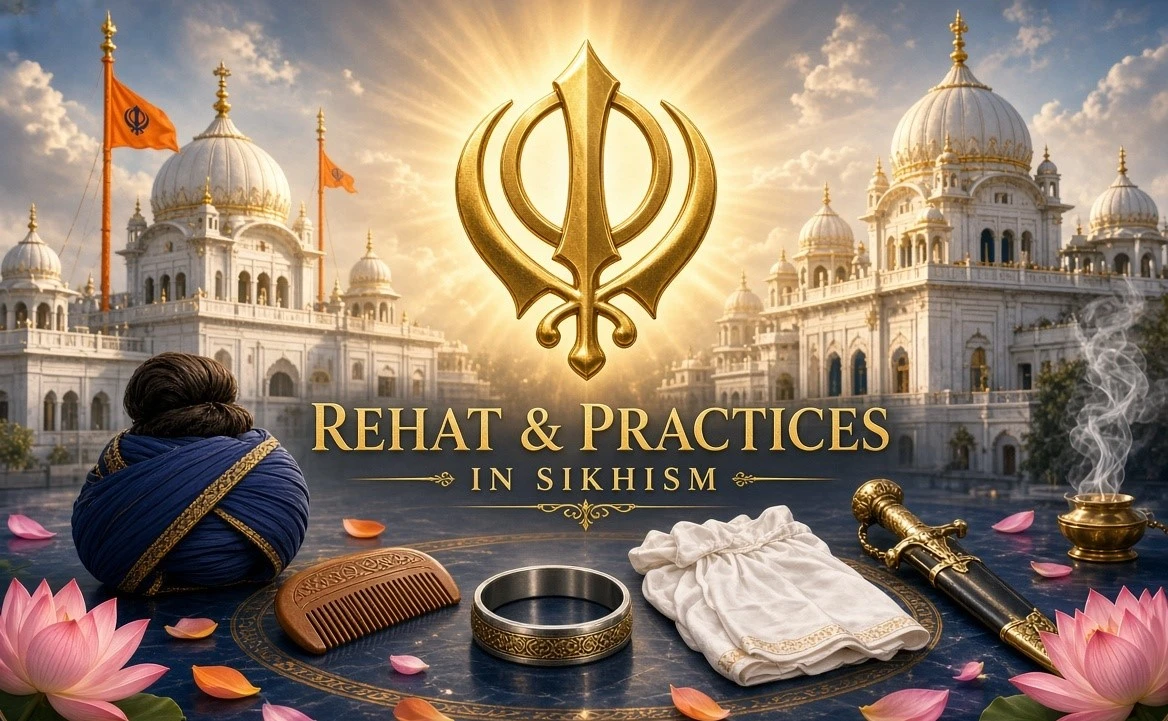
What Are Rehat and Practices in Sikhism?
Rehat
Rehat refers to a disciplined way of life according to Sikh teachings.
Sikh practices
Sikh practices are actions that express these teachings in daily life.
The Sikh Rehat Maryada
The Sikh Rehat Maryada is the code of conduct and practice of Sikhism. It sets out guidance on:
- Sikh identity
- Personal conduct
- Daily prayers
- Gurdwara worship
- Religious ceremonies
- Amrit initiation
- The Five Ks
- Responsibilities toward the Sikh community
The SGPC publishes an English version of the Rehat Maryada as the Code of Sikh Conduct and Conventions.
More than a list of rules
Sikh Rehat is not intended simply as a list of external rules. It connects spiritual discipline with ethical living.
Its broader purpose is to help Sikhs remember the divine, live authentically, transcend self, serve others, preserve Sikh identity and contribute to the welfare of humanity.
A useful way to understand Sikh practice
- Gurbani
- →
- Understanding
- →
- Discipline
- →
- Action
- →
- Service
What Is Sikh Rehat Maryada?
ਸਿੱਖ ਰਹਿਤ ਮਰਯਾਦਾ
The Sikh Rehat Maryada is the code of conduct and practice of Sikhism. It provides a framework for Sikh personal life, collective worship, rituals, Khalsa initiation, and Panthic duties.
The guidelines published by the SGPC include sections on:
- Sikh identity
- Daily prayers
- Gurdwara practices
- Anand Karaj
- Death-related commemorations
- Amrit consecration
- Violations of Sikh discipline
The term can be understood in two parts
Rehat
A disciplined lifestyle
Maryada
A code, practice or established religious practice
Daily Sikh Practices
Daily spiritual discipline is an important part of Sikh Rehat. The Rehat Maryada prescribes daily recitation or listening to specific scriptural compositions, including Japji Sahib, Jaap Sahib, Ten Sawayyas, Rehras Sahib, and Sohila Sahib. It also directs Sikhs to read or listen to recitation from the Guru Granth Sahib.
Japji Sahib
Composed by Guru Nanak Dev Ji
Japji Sahib is traditionally recited in the morning. It explores fundamental Sikh ideas about the Divine, spiritual development, Hukam, truthful living, and the transformation of the individual.
Morning remembrance provides a spiritual foundation for the day.
Jaap Sahib
Associated with Guru Gobind Singh Ji
Jaap Sahib is part of the prescribed daily prayers of the Khalsa. Its verses praise the Divine through a rich variety of names and descriptions, emphasizing the limitless and indescribable nature of the Divine.
Tav-Prasad Savaiye
Included in the daily Nitnem
The Savaiye emphasize sincere devotion and challenge empty ritualism, hypocrisy, and superficial religious identity.
They encourage a person to develop genuine spiritual awareness rather than relying only on outward appearances.
Rehras Sahib
Evening prayer
Rehras Sahib is traditionally recited in the evening. It provides an opportunity to pause after the day's activities, remember the Divine, express gratitude, and seek spiritual strength.
Sohila Sahib
Bedtime prayer
Sohila Sahib is traditionally recited at night. It contains hymns reflecting on the Divine, gratitude, mortality, and spiritual awareness.
Core Sikh Values
Six principles that turn faith into everyday living.
Remember the Divine
Sikh spirituality encourages constant remembrance of the Divine through Naam Simran, prayer, and Gurbani.
Live Truthfully
A Sikh is encouraged to make honesty and integrity part of everyday conduct.
Earn Honestly
Kirat Karo teaches responsible and honest work.
Share With Others
Vand Chakko encourages generosity and sharing.
Serve Humanity
Seva transforms spiritual values into practical service.
Maintain Equality
Sikh teachings reject discrimination based on caste, gender, social position, or other human divisions. The Sikh Coalition describes equality, love, and service as central aspects of the Sikh worldview.
What Is Nitnem in Sikhism?
Nitnem refers to the regular practice of reciting or listening to prescribed Sikh prayers.
For initiated Sikhs, the Rehat Maryada establishes specific daily compositions. These practices create a rhythm of spiritual remembrance across the day.
In simple terms
Nitnem and remembrance
Honest work, Naam, and Seva
Rehras Sahib
Sohila Sahib
The Five Ks of Sikhism
ਪੰਜ ਕਕਾਰ · Panj Kakkar
One of the most recognizable aspects of Sikh identity is the Five Ks, traditionally called the Panj Kakkar.
For Sikhs who have received Amrit initiation into the Khalsa, the Rehat Maryada requires maintaining these five articles of faith.
Kesh
Kesh means unshorn hair.
Maintaining kesh represents Sikh commitment to the Guru and acceptance of the natural form of the body. For initiated Sikhs, it is an essential part of Khalsa discipline.
Kangha
The Kangha is a small comb traditionally kept with the hair.
It represents cleanliness, order, and disciplined care of the body and hair, and is a practical reminder that spiritual discipline includes personal responsibility.
Kara
The Kara is a steel or iron bracelet worn on the wrist.
It is a visible reminder of one's relationship with the Guru and of the responsibility to act ethically. Its circular form speaks of continuity and restraint: actions should stay consistent with Sikh principles.
Kachera
The Kachera is a distinctive form of undergarment associated with Sikh discipline.
It represents modesty, self-control, and readiness, and is particularly associated with moral discipline and responsible conduct.
Kirpan
The Kirpan represents responsibility, courage, and the protection of justice and human dignity.
It should not be understood simply as a weapon. Within Sikh tradition, its significance lies in the responsibility to protect those who are vulnerable and to oppose injustice.
Together, the Five Ks form an important part of Khalsa identity and commitment.
Is the Five Ks Practice Required for Every Sikh?
This question needs an important distinction.
Initiated Sikhs
The Five Ks are prescribed for Sikhs who have entered the Khalsa through Amrit Sanchar. The Rehat Maryada directs initiated Sikhs to maintain all five articles.
Sikhs at different stages
Sikh communities include people at different stages of observance. Someone may identify as Sikh without having received Amrit.
The Five Ks are obligatory within Khalsa discipline for Amritdhari Sikhs; Sikh practice and observance can vary among Sikhs who have not taken Amrit.
ਅੰਮ੍ਰਿਤ ਸੰਚਾਰ
Amrit Sanchar: Initiation Into the Khalsa
Amrit Sanchar is the Sikh initiation ceremony through which a person formally enters the Khalsa.
-
A serious commitment
The ceremony represents a serious commitment to Sikh principles and discipline.
-
Rehat and the Five Ks
The person receiving Amrit commits to living according to Sikh Rehat and maintaining the Five Ks.
-
Conducted by the Panj Pyare
The ceremony is conducted according to established Sikh practice by the Panj Pyare, the Five Beloved Ones.
The Panj Pyare
The Five Beloved Ones, who conduct the ceremony.
ਬੱਜਰ ਕੁਰਹਿਤਾਂ
The Four Major Transgressions in Sikh Rehat Maryada
The Rehat Maryada identifies four major prohibited practices, traditionally referred to as Bajjar Kurehats.
Dishonouring the hair
Eating meat from an animal slaughtered according to the Muslim ritual method
Sexual relations outside one's marriage
Using tobacco
These are specifically identified in the SGPC-published Rehat Maryada as major transgressions.
Important clarification about food
The question of whether Sikhs can eat meat is frequently misunderstood.
Meat from an animal slaughtered according to the Muslim ritual method.
A universal vegetarian requirement for every Sikh.
The Sikh Coalition likewise explains that Sikhs may make personal choices about meat while noting the prohibition on ritualistically prepared meat and intoxicants.
This distinction is important because vegetarianism and the Rehat Maryada prohibition are not the same issue.
Sikhism and Intoxicants
Sikh Rehat places clear restrictions on intoxicants.
Tobacco
Tobacco is specifically prohibited.
Alcohol and narcotics
Sikh sources also describe intoxicants such as alcohol and narcotics as inconsistent with Sikh discipline.
The principle behind this discipline
It is connected with maintaining these four qualities.
Clarity
Self-control
Responsibility
Spiritual awareness
Seva — Selfless Service
Seva is one of the most important practices in Sikh life.
Seva means serving others without seeking personal recognition or reward.
It can include
Why is Seva important?
Seva helps transform spirituality from an internal belief into practical action. It develops:
The person performing seva should not seek status or praise. The focus is on serving.
Langar — Equality Through Practice
Langar is the community kitchen associated with Sikh Gurdwaras.
Food is prepared and served by volunteers and made available to people without discrimination based on:
Langar puts several Sikh principles into practice at the same time
Equality
Sharing
Seva
Hospitality
Community responsibility
It is therefore more than a free meal
Langar is a practical expression of Sikh equality and shared humanity.
Gurdwara Practices and Etiquette
A Gurdwara is a Sikh place of worship, learning, community, and service. Visitors from every background are welcome.
When you visit, please remember
These simple, respectful practices help everyone feel at home.
Cover your head
Visitors are expected to cover their heads while entering the Darbar Sahib.
Remove your shoes
Shoes are removed before entering the main prayer area.
Keep a respectful posture
Visitors should behave respectfully in the presence of Guru Granth Sahib Ji.
Avoid bringing intoxicants
Alcohol, tobacco, and other intoxicants should not be brought into the Gurdwara.
Participate respectfully
Visitors may listen to Kirtan, observe Ardas, sit with the Sangat, and accept Langar.
Accept Langar respectfully
Langar is offered to everyone. Sitting and eating together reflects Sikh principles of equality and community.
One meal. One row. Everyone equal.
Langar is the free community meal served in every Gurdwara. Everyone sits together on the floor and eats the same food, whatever their background.
You are welcome here.If you are unsure about anything, the Sangat will gladly guide you.
A Simple Daily Sikh Practice Framework
For someone learning about Sikh practice, the day can be understood as a flow, from morning to night.
-
Morning
- Nitnem
- Naam Simran
- Gratitude
-
Daytime
- Kirat Karo
- Truthful conduct
- Compassion
-
Throughout the day
- Remember the Divine
- Control ego
- Practise kindness
-
Service
- Seva
- Sharing
- Community responsibility
-
Evening
- Rehras Sahib
- Reflection
-
Night
- Sohila Sahib
- Remembrance
Sikh spirituality can become a way of life, not an activity limited to a Gurdwara.