Beliefs and Principles of Sikhism
Guiding values of equality, compassion, honest living, selfless service, remembrance of God, and devotion to truth.
The Foundation: One Formless God
Ik Onkar (ੴ), the belief that there is only one God who is formless, genderless, timeless, and present in all creation, lies at the core of Sikh teaching. This God, sometimes called Waheguru (“Wonderful Lord”), cannot be fully described by an image, a statue, or a single name. Instead, God is understood as a limitless, all-encompassing presence that anyone, regardless of background or faith, can approach through sincere devotion.
Nearly every other Sikh principle grows from this idea. Because God is one and lives in everyone, no person can be considered inherently better than another. This belief is the basis of Sikhism’s strong stand on equality, which is covered in more detail below.
❃ Living Sikhi Every Day ❃

Naam Japna (Remembering God)
This means keeping God always in mind through scripture recitation, meditation, and prayer. It is not an occasional ritual but an ongoing inner awareness woven into day-to-day activities.

Kirat Karo (Honest Living)
Sikhs are taught to earn their living honestly and morally, without fraud, exploitation, or corruption. Work itself is regarded as sacred and should never be looked down upon.

Vand Chakko (Sharing with Others)
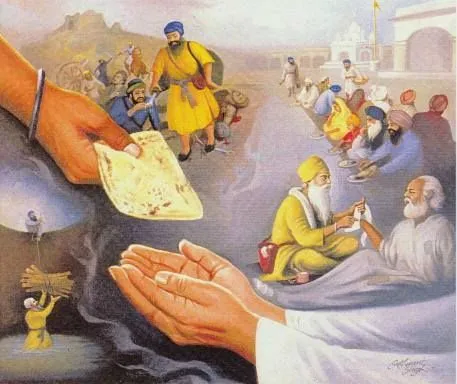
Sikhs are called to share their time, money, and resources with those in need. Institutions like langar, the free community kitchen found in every Gurdwara, are built on this idea.
What Are Seva, Sangat, and Langar?
Seva, Sangat, and Langar are three core Sikh practices that put equality, humility, and community service into daily life.
Seva: Selfless Service
Seva is selfless service done without expecting anything in return. It has three forms: Tan (physical service, such as cleaning a Gurdwara), Man (mental or devotional service), and Dhan (financial donation). Seva is seen as a simple way to dissolve the ego.
Sangat: The Sacred Assembly
Sangat is the holy congregation. Being in the company of fellow devotees is believed to give spiritual strength.
Langar: The Free Community Kitchen
Every Gurdwara runs a free community kitchen called Langar, where vegetarian food is served to everyone without exception. Guru Nanak began the practice in Kartarpur. Guru Angad and Guru Amar Das developed it further with the custom of “first pangat (eat together), then sangat,” making Langar a living rejection of caste. At the Golden Temple in Amritsar, Langar is said to serve tens of thousands of guests on regular days and over 100,000 on busy ones. Today, Sikh volunteers organize free meals in disaster zones and crises around the world, making Langar a well-known humanitarian model.
What Does Sikhism Teach About Other Religions?
Sikhism teaches that there is one God and that people of every religion can reach God through devotion, honest living, and compassion. Sikhs respect other faiths, reject forced conversion, and have a strong tradition of defending religious freedom. At the same time, Sikh scripture criticizes empty ritual, caste, and hypocrisy in any tradition, and Sikhs follow their own path, the teachings of the Gurus, without claiming that only Sikhs can find God.
Key Takeaways
- Truth is not owned by any religion, and God is one (Ik Onkar).
- Hymns by Hindu, Muslim, and other saints can be found in the Guru Granth Sahib.
- Sikhism criticizes rituals, idolatry, and caste rather than individuals or their freedom of religion.
- God’s grace and one’s lifestyle, not one’s religious affiliation, determine liberation.
- Sikhs are against coerced conversion. Guru Tegh Bahadur Ji sacrificed his life to protect others’ freedom of religion.
- Throughout Sikh history, there have been times of intense interfaith friendship as well as times of strife, most of which have been related to politics and power rather than religion.
Sikh Views on Other Religions at a Glance
- Is there one God for all people?
- YesIk Onkar, one Creator of all.
- Can followers of other religions reach God?
- YesLiberation comes through God’s grace and a truthful life, not through membership of a group.
- Are all religious practices equally valid?
- Not necessarilySikh scripture criticizes ritualism, caste, and hypocrisy in every tradition.
- Should Sikhs convert others by force or pressure?
- No
- Do Sikhs accept converts?
- YesAnyone may embrace Sikhism voluntarily.
- Should Sikhs defend others’ religious freedom?
- YesThis is a central part of Sikh history.
- Do Sikhs respect other scriptures?
- YesGurbani tells people not to dismiss them as false.
- Can non-Sikhs enter a Gurdwara and eat Langar?
- YesAll are welcome.
Is Sikhism Only About Believing in God?
No, Sikhism does teach belief in a single God (Ik Onkar), but belief is merely the beginning. Through meditation on God’s Name (Naam Japo), honest work (Kirat Karo), sharing with others (Vand Chhako), selfless service (Seva), and advocating for justice, Sikh doctrine encourages people to integrate their faith into their daily lives. In Sikhi, a person’s life demonstrates their faith.
Key takeaways
- Sikhism is more than just belief; it’s a way of life.
- Truthful living is even more important than truth itself, according to the teachings of the Sikh Gurus.
- Sikhi promotes lifelong learning and inquiry. Sikh is a word that signifies “learner.”
- Faith manifests itself in the hands (service and honest effort), the heart (devotion), and the head (understanding).
- The objective is not to withdraw from the world. The engaged householder is favored in Sikhism.
- Outward displays, rituals, and pilgrimages cannot take the place of internal transformation.
- Sikhs are not supposed to be flawless. They are supposed to continue growing and learning.
Sikhism at a Glance: Belief-Only Faith vs the Sikh Path
| Question | Belief-only approach | Sikh approach |
|---|---|---|
| What is faith? | Agreeing with a statement | Living in trust of one God, every day |
| What proves sincerity? | What a person says or declares | How a person earns, speaks, and serves |
| Role of ritual | Central | Never a substitute for inner change |
| Role of work | Separate from spirituality | Honest work is part of worship (Kirat Karo) |
| Role of community | Optional | Essential (Sangat) |
| Attitude to the world | Often withdrawal | Engaged householder life |
| Attitude to injustice | Personal matter | A spiritual duty to resist it (Miri-Piri) |
| Goal | Belief held | Ego dissolved, union with God (Mukti) |
Frequently Asked Questions About the Beliefs and Principles of Sikhism
What are the main beliefs of Sikhism?
One Divine Reality (Ik Oankar), equality of all people, recollection of the Divine, truthful life, honest work, sharing with others, selfless service (seva), humility, and living in accordance with the teachings of the Guru Granth Sahib are among Sikhism’s core values. Sikhism links moral behavior and daily living with spiritual belief.
What does Ik Oankar mean in Sikhism?
The Sikh belief in a single divine reality is expressed in Ik Oankar (ੴ). Sikh teachings place a strong emphasis on the idea that everyone has equal spiritual dignity and that the Divine is not exclusive to any one community or social group. The Sikh values of equality, love, and service are strongly related to this sense of unity.
Does Sikhism believe that everyone is equal?
Yes. In Sikhism, equality is a core value. The notion that a person’s spiritual value is determined by their caste, gender, social standing, or financial status is rejected by Sikh beliefs. The idea that all people should be treated equally and with dignity is supported by the Sikh conception of divine oneness.
What does Sikhism teach about caste?
Sikhism rejects caste-based ideas of human superiority and inferiority. Sikh teachings emphasize that people should not be considered spiritually higher or lower because of their birth or family background. Equality is also expressed through Sikh community practices such as Sangat and Langar, where people come together without caste-based distinctions.
What does Sikhism teach about truthful living?
Sikhism teaches that truth should be reflected in the way a person lives, not merely in what they say. Truthful living involves integrity in one’s thoughts, words, work, relationships, and actions. Sikh teachings place moral character and truthful conduct at the heart of spiritual development.
What is Hukam in Sikhism?
Hukam refers to the Divine Order or the way in which existence unfolds according to the Divine. Sikh teachings encourage people to recognize Hukam, develop humility, and live responsibly rather than allowing ego and personal attachment to control their lives.
What are the Five Thieves in Sikhism?
The Five Thieves are commonly identified as Kaam (lust or uncontrolled desire), Krodh (anger), Lobh (greed), Moh (attachment), and Ahankar (ego or pride). Sikh teachings encourage individuals to overcome these tendencies through remembrance of the Divine, self-discipline, humility, and virtuous living.
Does Sikhism encourage people to leave family life to become spiritual?
No. Sikh teachings emphasize living a spiritual life while participating responsibly in family and community life. A Sikh can pursue spiritual growth while working, supporting a family, serving society, and fulfilling everyday responsibilities. Guru Nanak Sahib’s teachings emphasize honest work and sharing rather than withdrawing from ordinary life.
What is the relationship between Sikhism and service to humanity?
Service to humanity is closely connected with Sikh spirituality. The Sikh concept of seva expresses the belief that recognizing Divine oneness should lead to caring for others. Service is therefore not only charitable activity; it can also be a spiritual practice that develops humility, compassion, and responsibility.
What is the main purpose of Sikh spiritual life?
Sikh spiritual life aims to develop a person’s relationship with the Divine while transforming how they live. This includes remembering the Divine, overcoming ego, developing truthful and compassionate character, serving others, and living responsibly within the world. Sikhism therefore presents spirituality as a way of life rather than simply a collection of beliefs.